
 +86-15829394411



0102030405
How to Select the Right Perforating Gun Size for a Well
2026-10-09
Selecting the right perforating gun size is an important step in planning a successful well perforation operation. The gun diameter affects more than whether the assembly can pass through the wellbore. It can also influence the available shaped charge size, shot density, perforation performance, and compatibility with the selected conveyance system.
For completion engineers and oilfield service companies, the objective is to choose a perforating gun that fits the well conditions while meeting the required operational and performance criteria. A gun that is too large may encounter restrictions during deployment or retrieval, while an unnecessarily small gun may limit the available perforating configurations. The right selection requires evaluating several factors together rather than relying on casing size alone.
1. Start with Casing Size and Actual Wellbore Clearance
The first step in perforating gun size selection is to review the well's completion design and internal dimensions. Casing size is an important starting point, but the nominal casing diameter does not represent the actual space available for the gun assembly.
Engineers should verify the casing's internal diameter and consider the minimum drift diameter where applicable. The distinction matters because casing wall thickness, connections, deformation, and other downhole restrictions can reduce the available clearance.
The full wellbore completion should also be reviewed for restrictions. In through-tubing operations, for example, the gun must pass through the tubing and any relevant restrictions, which may impose a much tighter diameter limit than the production casing itself.
The maximum usable gun diameter must therefore be established from the smallest relevant restriction along the planned deployment path, with suitable clearance for the specific tool design and operating conditions. Engineers should also consider whether the gun assembly must pass back through the same restrictions after firing.
2. Consider the Conveyance Method: Wireline or TCP
The conveyance method is another key factor when selecting a perforating gun size. Wireline perforating and tubing-conveyed perforating (TCP) have different operational requirements, which can affect the practical choice of gun diameter and configuration.
In wireline operations, the gun assembly is deployed using an electric line or another suitable wireline system. Gun diameter must be compatible with the wellbore restrictions, while the overall assembly must also meet the conveyance system's load, length, and operational limitations. Well deviation and trajectory may further influence deployment feasibility.
TCP systems are conveyed as part of a tubing or completion string. This arrangement can allow different gun lengths and configurations, depending on the completion design and running method. However, TCP gun diameter is still constrained by the available internal clearance and the requirements of the complete assembly.
Neither method automatically requires a larger or smaller gun in every application. The appropriate choice depends on well geometry, completion architecture, operational objectives, and the capabilities of the selected equipment.
3. Balance Gun Diameter with Perforation Performance
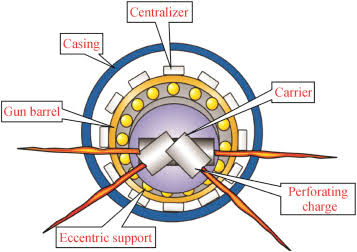
Gun size can influence the perforating performance that a system can deliver. A larger gun may accommodate larger shaped charges or provide more flexibility in charge arrangement, shot density, and phasing. These factors can affect perforation characteristics and the number of perforations created within a given interval.
However, a larger gun does not automatically guarantee better well performance. The result also depends on shaped charge design, penetration depth, entrance hole diameter, casing and formation properties, and the objectives of the completion.
For example, a project targeting deep penetration in a particular formation may require a different charge configuration from one prioritizing larger entrance holes or a high number of perforations per unit length. Engineers should evaluate gun diameter alongside the performance data for the specific shaped charge and gun system rather than treating diameter as an independent measure of effectiveness.
Test data can help compare candidate configurations, provided the results are interpreted in the context of their test conditions. API RP 19B describes standardized procedures for evaluating perforating equipment performance, including testing under defined target and environmental conditions. Such data can support technical selection, but it should not be treated as a guarantee of identical results in every well.
4. Evaluate Well Conditions and Operational Requirements
Beyond casing dimensions and perforation performance, the well's operating environment must be considered. Downhole temperature and pressure can affect the suitability of the selected shaped charges, materials, and other system components. The equipment's rated operating limits should be verified against the expected well conditions and exposure duration.
Well deviation, dogleg severity, and the condition of the wellbore can also influence whether a particular assembly can be deployed and retrieved as planned. In complex wells, engineers may need to assess the complete gun string and its interaction with other completion equipment rather than evaluating the gun body alone.
The required perforation interval, shot density, phase angle, and retrieval requirements should be confirmed during the same selection process. These parameters influence the overall gun configuration and should remain consistent with the well's completion objectives and operational plan.
5. Confirm Compatibility Before Finalizing the Selection
Before ordering or deploying a perforating gun, engineers and purchasing teams should confirm that the proposed configuration matches the project specifications. A practical review should cover:
- Dimensional compatibility: Gun outside diameter, casing or tubing internal diameter, minimum restrictions, and required clearance.
- System compatibility: Connections, gun subs, charge carriers, firing system, and other components required by the selected configuration.
- Performance requirements: Shaped charge specifications, shot density, phase angle, and the required perforation characteristics.
- Operating conditions: Temperature, pressure, well trajectory, and the expected deployment and retrieval conditions.
- Technical documentation: Applicable product specifications, inspection records, and performance test data relevant to the proposed configuration.
For customized perforating systems, providing the manufacturer with accurate well and completion information can help narrow down suitable configurations and identify potential compatibility issues before delivery.
Conclusion
Choosing the right perforating gun size requires balancing wellbore clearance, conveyance requirements, perforation performance, and operating conditions. Casing size provides the starting point, but the final decision should be based on the actual restrictions and requirements of the complete well system.
FYPE manufactures perforating guns, shaped charges, and associated completion hardware for wireline and TCP applications. By reviewing the well conditions, required specifications, and system compatibility, operators and service companies can work with the manufacturer to identify a suitable perforating gun configuration for their completion requirements.