
 +86-15829394411



0102030405
Stuck Pipe in Oil and Gas Wells: Causes, Risks and Back-Off Solutions
2026-09-03
Stuck pipe is one of the most common and costly downhole problems encountered during drilling, completion, and well intervention operations. When a tubing, casing, or drillstring becomes stuck, normal movement may no longer be possible, making it difficult to continue the operation or retrieve the downhole string.
The causes of stuck pipe can vary from wellbore conditions and formation characteristics to mechanical restrictions and differential pressure. When conventional methods cannot free the stuck string, a back-off operation may be considered to recover the free section while leaving the stuck portion downhole.
Among the available intervention methods, explosive back-off tools provide a specialized solution for disconnecting stuck tubular strings at a selected threaded connection.
What Is Stuck Pipe?
Stuck pipe refers to a condition in which a tubular string or downhole tool becomes immobilized and cannot be moved as required.
Depending on the nature of the problem, the string may be unable to:
- Run further into the well
- Be pulled out of the well
- Rotate freely
- Move through a restricted section
- Respond normally to applied tension or torque
Stuck pipe can occur during drilling, completion, workover, and other well intervention operations. The earlier the cause is identified, the greater the opportunity to recover the string without resorting to more complex intervention methods.
Common Causes of Stuck Pipe
The causes of stuck pipe are generally associated with either formation conditions, wellbore geometry, or mechanical interaction between the tubular string and the wellbore.
Differential Sticking
Differential sticking can occur when a tubular is forced against the wellbore wall by differential pressure. This is particularly relevant when the pressure exerted by the drilling fluid exceeds the formation pressure and a filter cake develops along a permeable formation.
In this situation, the pipe may become firmly held against the wellbore wall, making normal movement difficult.
Mechanical Sticking
Mechanical sticking occurs when the tubular string encounters a physical obstruction or restriction in the wellbore.
Possible causes include:
- Wellbore restrictions
- Undersized or damaged sections
- Formation ledges
- Keyseats
- Junk or debris
- Poorly conditioned wellbore sections
Mechanical sticking may prevent the string from being moved even when sufficient pulling force or torque is applied.
Wellbore Instability
Unstable formations can contribute significantly to stuck-pipe incidents. Sloughing shale, wellbore collapse, swelling formations, or other formation-related problems may reduce the effective wellbore diameter and restrict tubular movement.
Wellbore instability can also result in additional cuttings or debris entering the annulus, further increasing the risk of sticking.
Cuttings and Debris Accumulation
Poor hole cleaning can allow cuttings to accumulate around the tubular string. If the accumulation becomes severe, the pipe may become increasingly difficult to move or may eventually become completely stuck.
This risk can increase in highly deviated or horizontal wells where cuttings transport is more challenging.
Keyseating and Wellbore Geometry
Changes in wellbore trajectory can create localized restrictions. Doglegs, keyseats, ledges, and other irregularities may interfere with the movement of the tubular string, particularly during tripping operations.
Understanding the wellbore geometry is therefore important when diagnosing the cause and location of a stuck-pipe incident.
Why Is Stuck Pipe a Serious Problem?
A stuck-pipe incident can interrupt the planned operation and lead to significant additional costs.
The consequences may include:
- Non-productive time
- Additional fishing or intervention operations
- Damage to downhole equipment
- Delays to drilling or completion schedules
- Increased operational and service costs
- The need to leave part of the tubular string downhole
The response depends heavily on where the pipe is stuck and whether the stuck section can be freed. Accurate identification of the stuck point is therefore an important part of the recovery strategy.
When the free section cannot be recovered by conventional freeing techniques, a back-off operation may provide another option.
What Is a Back-Off Operation?
A back-off operation is used to disconnect the free section of a tubular string from the stuck section at a selected threaded connection.
Once the connection is successfully backed off, the free portion of the tubing, casing, or drillstring can be recovered from the well. The remaining stuck section can then be addressed through subsequent fishing, milling, or other intervention operations.
The appropriate back-off method depends on factors such as the tubular configuration, connection type, stuck-point depth, downhole conditions, and available intervention equipment.
When conventional mechanical methods are not sufficient, explosive back-off can provide an alternative solution.
How Does an Explosive Back-Off Tool Work?
An explosive back-off tool generates a localized impact force at or around the selected threaded connection.
When the explosive system is initiated, the resulting high-energy shock load is transferred to the connection. This helps reduce the holding force of the connection and facilitates loosening and back-off.
Tool selection and configuration depend on the specific well conditions, including:
- Stuck-point depth
- Tubular specifications
- Connection design
- Tubular steel grade
- Drilling fluid density
- Downhole temperature and pressure
- Required impact level
Because downhole conditions can vary considerably from one well to another, the tool and explosive configuration should be selected according to the actual application requirements and applicable operating procedures.
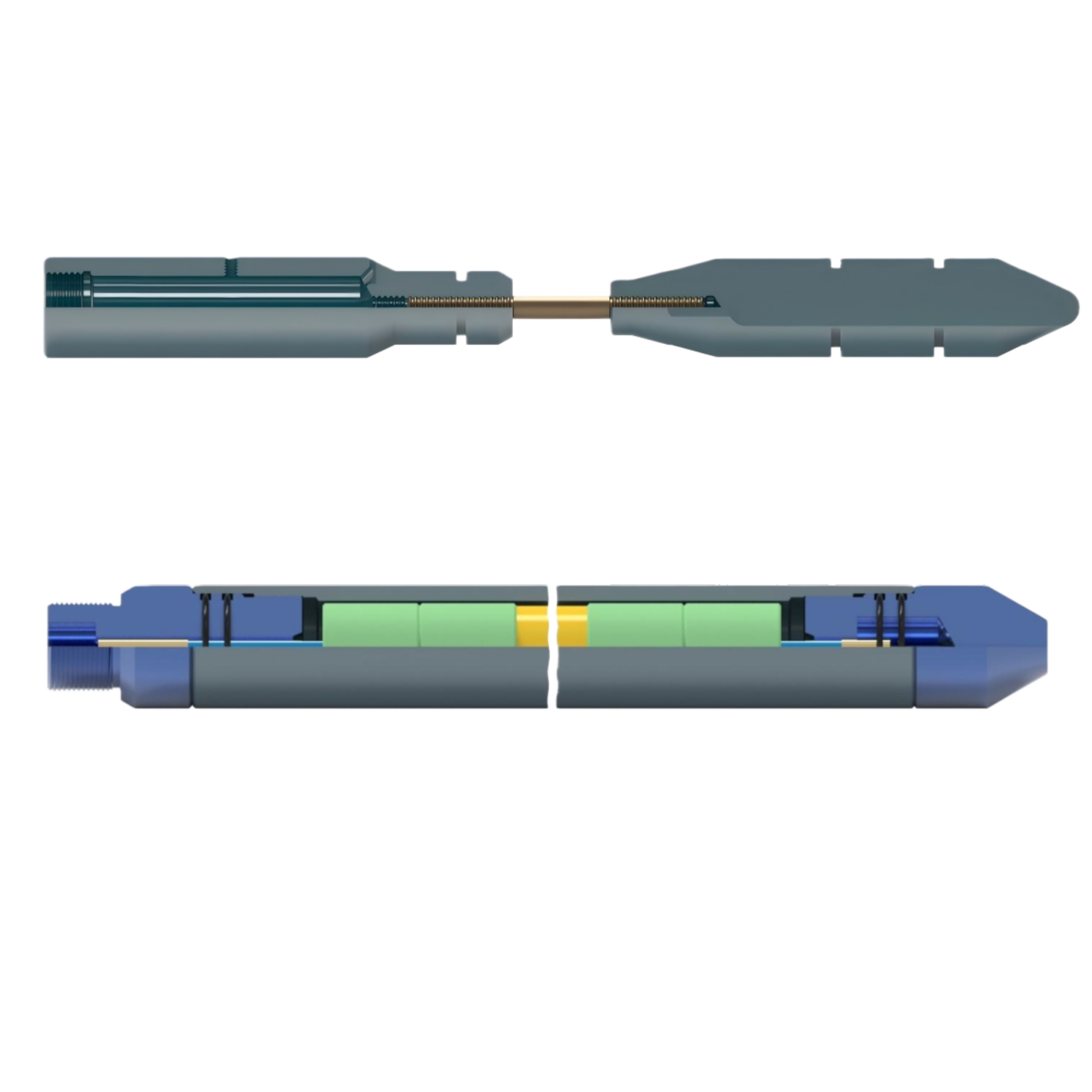
Explosive Rod Back-Off Tool

The Explosive Rod Back-Off Tool is designed for emergency back-off operations involving stuck tubing and casing.
The tool uses a detonating cord arranged around the explosive rod. When initiated, the detonating cord generates a high-energy impact around the tool. The resulting force is transferred to the selected threaded connection to facilitate loosening and back-off.
The configuration of the tool is determined according to factors such as the stuck-point depth, drilling fluid density, tubular specifications, steel grade, connection characteristics, and other downhole conditions.
The rod-type design provides a practical option for emergency stuck-pipe recovery where explosive back-off is required.
Explosive Tube Back-Off Tool

The Explosive Tube Back-Off Tool is designed for explosive back-off operations involving stuck tubing and casing, particularly where demanding deep-well conditions need to be considered.
Unlike the rod-type design, the explosive charges are installed inside the explosive tube body. When initiated, the charges generate an impact force that is transferred to the threaded connection to facilitate back-off.
The enclosed configuration provides an integrated structure for the explosive charges, while the tool body is designed to withstand the combined effects of high temperature and high pressure. This makes the explosive tube design particularly suitable for deep-well applications where downhole environmental conditions are more demanding.
The number and configuration of explosive charges can be selected according to the specific well and tubular requirements.
When Are Explosive Back-Off Tools Considered?
Explosive back-off is generally considered when a tubular string remains stuck and conventional freeing methods are unsuccessful or impractical.
A typical decision process involves determining:
1. The location of the stuck point
The free and stuck sections need to be identified before selecting an appropriate intervention strategy.
2. The condition of the tubular string
Tubular size, steel grade, connection type, and mechanical condition can influence the back-off method.
3. Downhole conditions
Well depth, temperature, pressure, drilling fluid properties, and wellbore configuration should all be considered.
4. The required back-off method
Based on the above conditions, an appropriate explosive back-off tool and configuration can be selected.
Explosive back-off should be treated as a specialized downhole intervention operation and carried out by qualified personnel under established safety and operational procedures.
Our Explosive Back-Off Tools
Our Explosive Rod Back-Off Tool and Explosive Tube Back-Off Tool are designed for emergency stuck-pipe recovery and tubing/casing back-off applications.
The rod-type tool uses a detonating-cord arrangement around the explosive rod to generate the required impact force at the threaded connection. The tube-type tool houses explosive charges inside the tool body and is designed to withstand demanding high-temperature and high-pressure downhole conditions, making it suitable for deep-well applications.
Both designs can be selected and configured according to the well conditions, tubular specifications, stuck-point characteristics, and operational requirements.
For more information about our Explosive Back-Off Tools and other downhole intervention solutions, please contact our technical team.